When I advertise as a life coach specializing in mental health and recovery, people assume I only work with those who have a mental illness. I prefer not to look at health and wellness as the opposite to illness, and I understand both health and illness to be a possibility for all of us. Norman Bates, in the novel & movie Psycho, said it the best: “We all go a little crazy sometimes.”
If we can stop seeing health as a privilege given to some and illness a deficit bestowed upon others, I think we can do better as human beings to understand ourselves and those around us. Stigma stems from preconceived and illogical notions, and the idea that anyone is safe from imbalance and crisis is entirely irrational. As a life coach specializing in mental health recovery, I do not work with people who have mental illness; I work with people who are seeking a higher level of mental health, no matter where they are starting out.
What Is Mental Health?
According to the World Health Organization, mental health is “…a state of well-being in which the individual realizes his or her own abilities, can cope with the normal stresses of life, can work productively and fruitfully, and is able to make a contribution to his or her community.
And according to the Canadian Association of Social Workers, it is “…the capacity of the individual, the group and the environment to interact with one another in ways that promote subjective well-being, the optimal development and use of mental abilities (cognitive, affective and relational), the achievement of individual and collective goals consistent with justice and the attainment and preservation of conditions of fundamental equality.”
Both definitions describe mental health as a set of determinants that we can all relate to; at some point in our lives, we have been able to make a difference, participate in meaningful activities, make decisions for ourselves that enhance our wellbeing. But how many of us can say we are always in a state of mental health and wellness? You don’t need to have a diagnosed illness to feel that you are currently not in control of your opportunities, or that you are unable to attain your goals. You may have difficulties at work, in your family life, or with intimate relationships – you are not mentally ill, but on some level, you are temporarily unwell. And that’s ok, we are go to that place. Most of us have the coping mechanisms and resources and move out of a state of imbalance and back to wellness. So it is with life, a constant cycle in and out of balance.
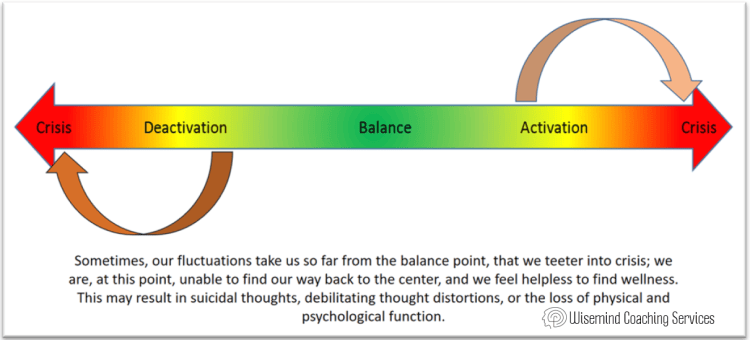
In this way, I have learned to describe mental health on a spectrum. One of the organizations that emphasizes the mental health spectrum is the Canadian Mental Health Association (CMHA), though I have not been able to find a perfect reference to their work. Here is my interpretation of a presentation I saw from a CMHA worker:
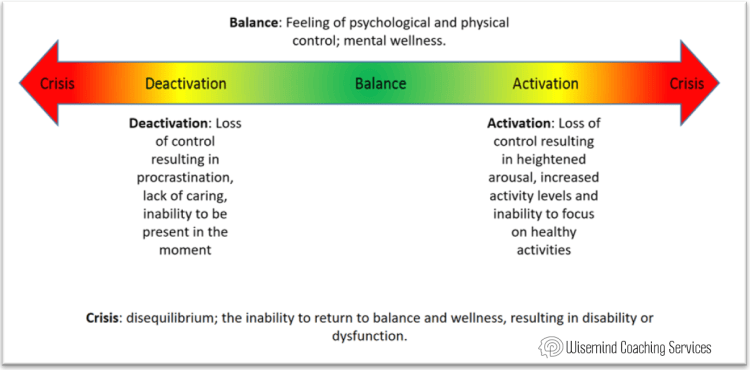
Any life circumstance can take us from the basic definition of mental health, or Balance, to any extreme on this scale. Most of us can handle movements to the right or the left, simply because we have built up coping mechanisms that help us maintain function. We have a negative performance evaluation at work that Deactivates us, and we feel less competent in our jobs. But we go home and talk to our family or call up a good friend, and we find balance again. We discover a new hobby and become Activated, to the point where we forget our priorities and obligations. Eventually, something brings us down to earth and we figure out how to go back to our normal schedule.
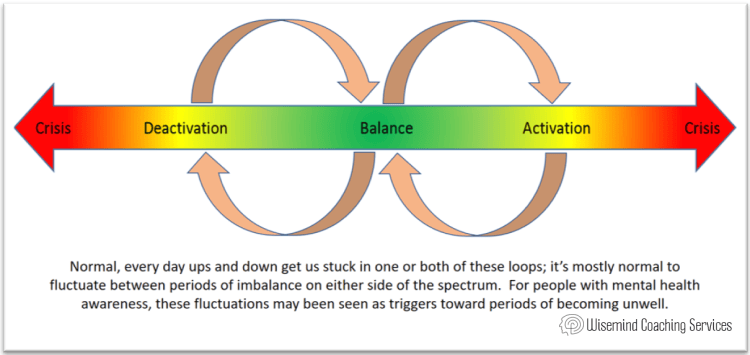
But what happens when we can’t anchor ourselves? We continue to move along the spectrum when we don’t have the proper coping mechanisms or we don’t have the right resources to help us back. What if, after that performance evaluation, you went home to an empty house and had no one to call? What if your job and employment success was the only thing you felt tethered to? A negative evaluation might throw you further down the spectrum into Crisis. Alternately, an inability to find and maintain priorities might turn a fascination with social media or a new video game into your full-time obsession. Crisis is a serious state of mind where we have gone so far from balance that we can’t find out way back.
So mental health and wellness is not exclusive of mental imbalance and illness. We are all capable of function and dysfunction, and our diagnoses or lack thereof does not protect us. Balance and illness are on the same spectrum, and as human beings, we all walk the same paths.
Just as the Mental Health Spectrum can help us understand what mental wellness is and is not, it can also be a starting point to taking control of our movements along the spectrum. If we understand how we got to the Deactivation and Activation points, we can start to crawl our way back to Balance. Likewise, in times of Crisis, self awareness can bring us closer to control.
My next blog post will expand on this to answer the question, “What is Recovery?” and I will use the core knowledge in this post to help you understand how I work as a life coach to help anyone at any point on the spectrum start to seek out recovery and gain control of their mental wellness.
See you soon!
References and Links
WHO Definition of Mental Health: http://www.who.int/mental_health/evidence/en/promoting_mhh.pdf
CASW Definition of Mental Health: https://casw-acts.ca/en/role-social-work-mental-health
Take the Mental Health Meter and see where you might land on the Mental Health Spectrum! https://cmha.ca/mental-health-meter/


One thought on “The Mental Health Spectrum: Getting Closer To Understanding Mental Health And Wellness”